
Token Manager
AI agents aren't expensive. Unoptimised token calls are.
Big players — Oracle included — have said that an AI agent will soon cost the same as hiring a person. That's a misunderstanding. It isn't the intelligence that's expensive. It's the way it gets called.
Why the bill runs away
It's easy to use Claude, Claude Code, OpenAI and Copilot in an interface. The price is known, and usage feels free. But agents don't work in an interface — they work through API keys, and they call again and again, around the clock, without anyone watching the meter spin.
That's when it gets expensive. Not because the technology is expensive, but because the biggest model is used for the smallest task, because the same context is sent every time, and because nobody has set a limit.
- The top model is used for trivial calls
- The same context is sent again and again
- No caching of what doesn't change
- No budgets or alerts per agent
- Nobody owns the bill internally
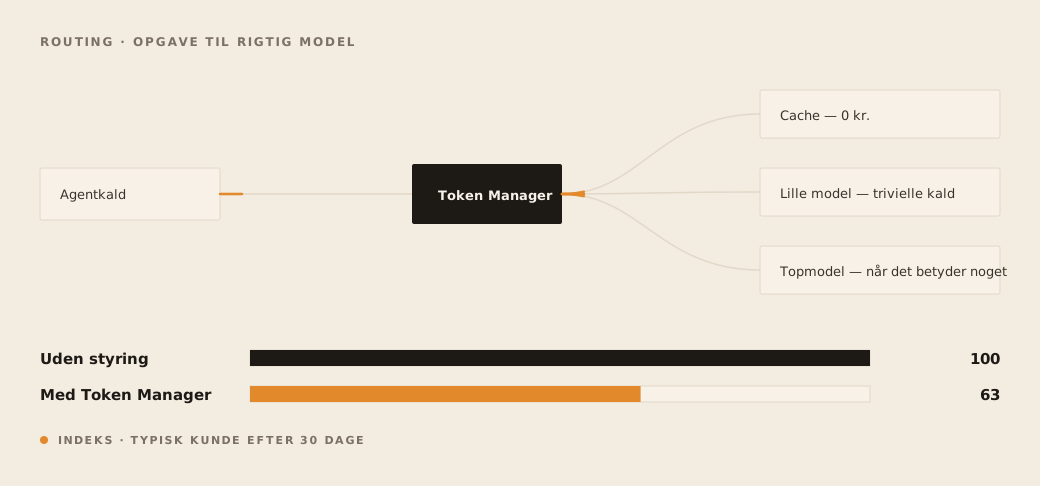
Same tasks — half the bill
How we optimise
Mapping
We go through every system, agent and integration and measure what each call actually costs.
Deliberate model choice
The right model for the right task. The big model where it makes a difference — the small one where it doesn't.
Context and caching
We cut out what isn't needed and reuse what is stable, instead of paying for it every time.
Budgets and alerts
Caps per agent, per team and per month — with a warning before the number surprises you.
Ongoing monitoring
Usage per agent, per task, per day. In the same place as your other key figures.
Negotiation and choice
We play suppliers and models off against each other when prices move — and they move often.
What it usually delivers
In our experience, an average AI-aware mid-sized company can save 30–40% of its technical operating costs through deliberate model choice and structured context alone — without the agents getting worse. Often they get faster.
It isn't a saving you make once. Prices, models and usage change every month, so Token Manager keeps running as an ongoing function, not a project.
- Typical saving
- 30–40%
- Without loss of
- Quality
- Follow-up
- Ongoing
What do your agents really cost?
We review your usage and show where the money goes — and where it doesn't need to go.
Talk to Roger